I just want to feel free
“Over time I get to know myself better and better and one thing that’s really true for me is that I hate having too many options. Even now, if I carry a second lens with me I’m in turmoil because I always think I should have the other one on, so I have to keep things very regimented and routine to a certain degree in order to feel free and to be able to focus on the part that really matters, which is pictures. I just want to feel free, and I mean that about everything in my practice. It’s not just about gear. It’s also about how I think about what I’m doing.”
Reuben Radding from Being Free of Photography Dogmas -- Walkie Talkie with Reuben Radding
Photo by me
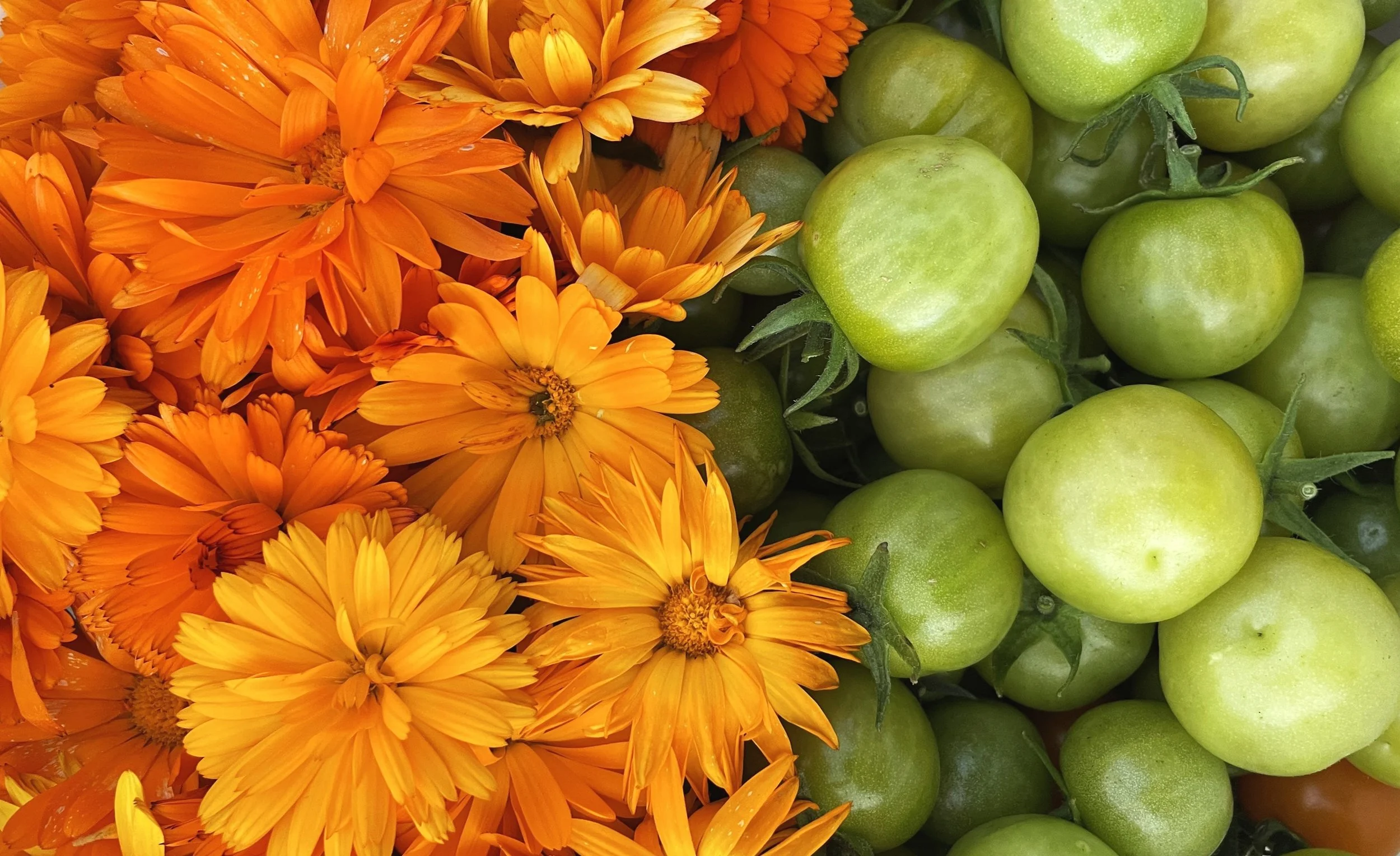
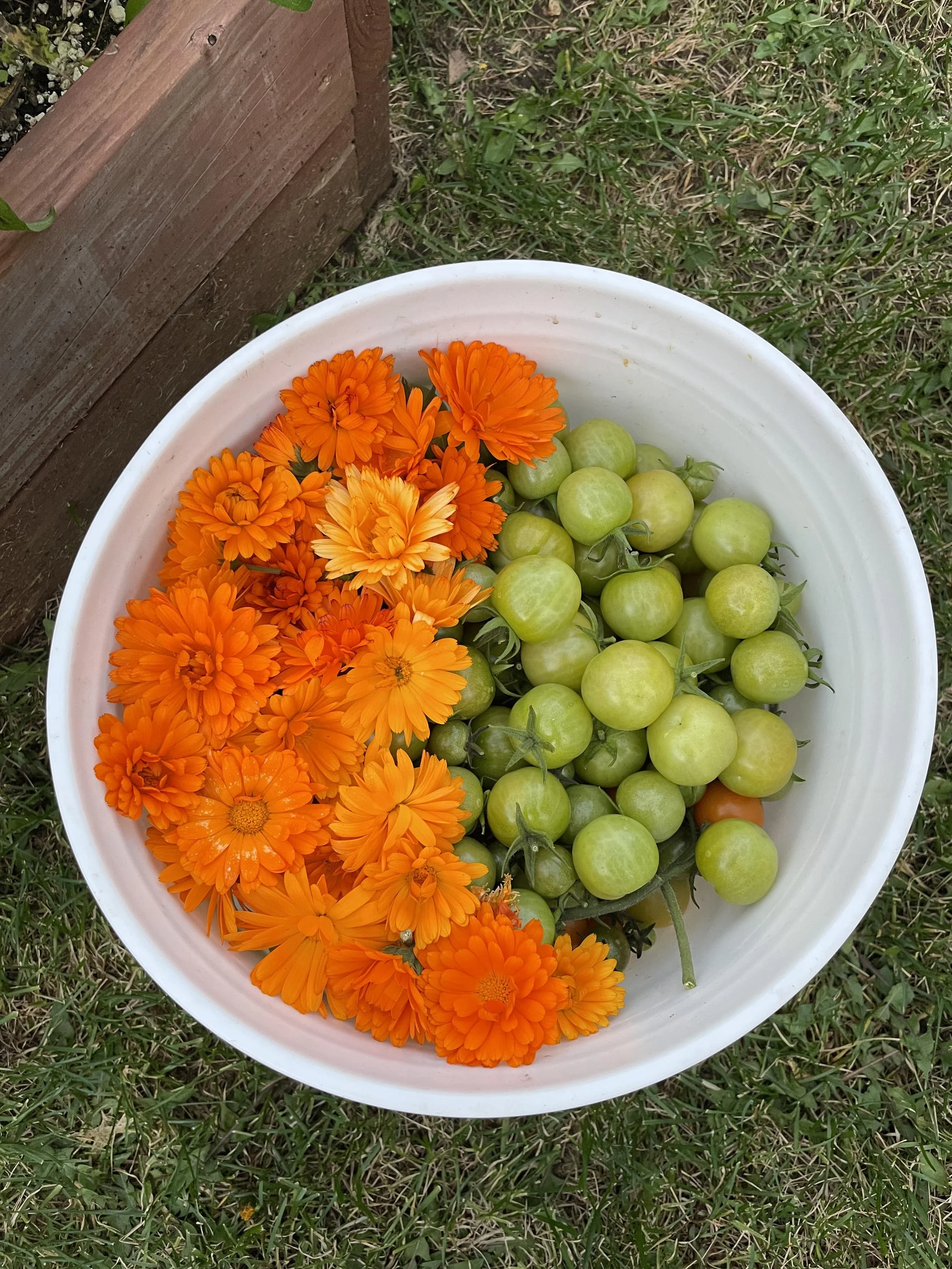
a culling
Calendula & Green Tomatoes. I can smell these photos…
A Different Story [August, 2019]
A Different Story.
Last November, I found myself in search of a new art endeavor. Photography had been my form of expression for the past dozen years, but it just wasn’t pulling me in anymore. I had heard of altered books before, as “a found or re-purposed book that is transformed into a work of art to express a healing journey. Pages are painted, torn or collaged to explore new meanings and ideas. The artist can interact with the words or illustrations on the printed page, or create totally new ones.”
I loved the idea of a continuous project that was more about the process than the product. I came across Pat Conroy’s Beach Music at a used book sale. I had never heard of it but it fit my criteria: thick enough to keep me busy for a while. As I made my way through the book, I was able to avoid the paralysis of perfection that had often stopped me from creating visual art. I simply put down whatever came to mind and moved on to the next page. Some pages took hours, others took minutes.
As I continued through Beach Music, I started to loosely follow along with the narrative. I realized how closely the details in the story matched those of my life. The story is about the aftermath of a man losing his wife, Shyla, to suicide and his decision to travel to foreign land to start anew. Two years ago, I lost one of my moms, Tyla, to suicide, and I set off to Alaska in hopes of doing the same.
I never thought a book I randomly pulled off a shelf would hit so close to home. I started to see pieces of my life in other stories, books, and poems that I read. Words hidden in the pages that often explained my thoughts and feelings better than my conscious self ever could. It lead to me feel much less alone in the world. Although we may have different stories, there is a thread that connects each of us, even if it’s buried from plain sight.
Jesse Rosenstein is an artist/photographer/filmmaker from Baltimore, MD who moved to Alaska in 2017. More work can be found at www.jesserosenstein.com
a day at the museum
kane & tina


a person on a mountain
windy elixirs
a windy weekend getaway
The artist didn’t have time to make it pretty
I get how what you’re saying [about surrendering to a world with certain values and attributes] makes sense for a novel like “1984,” but how does it make sense for art forms like nonnarrative music, which you make, or abstract paintings?
That’s the most interesting question you could have asked. I’m absolutely fascinated by this question, because I think I have an answer, and I don’t think it has ever been well answered. What happens when you go look at a painting you’ve never seen before? What I think happens is that when you look at that picture, you’re seeing it in the context of all the other pictures you’ve ever seen. When you go and look at something new, what you’re saying is, “What’s different about this experience?” In many instances, there won’t be anything different, in which case you’re not that interested. But if you can look at it and say, “That’s more angular. That’s fuzzier. That’s much more this, much more that” — we’re very good at understanding differences in feeling within our own long narrative of looking at pieces of work. But what does it mean, for example, when a picture is scratchier than another? You read that as, This is urgent. The artist didn’t have time to make it pretty. We read messages that don’t have a text quality to them, and we still pick up on the ideas that make them different. Or take Bauhaus. When Bauhaus comes along, it’s saying, “We no longer think of the world as divided into beautiful things and functional things.” That’s a philosophical position about the world. Art, even when it’s nonnarrative, makes those kinds of points all the time.
Burning the midnight oil
sedimentary cradle
on the edge
quilted
sup


Teaching English to my coworkers
resignation
Gratitude
I reached out to Joshua Corbett the first day I arrived in Alaska. I had seen his work in The New York Times and wanted to pick his brain about freelance photography. Josh sat with me for hours and we geeked analog photography, film making, and Alaska (my new home). He said he’d do his best to get some work for me. Sure enough, he let me assist on a few video shoots. If you ever see this, Josh, I’m grateful for you.